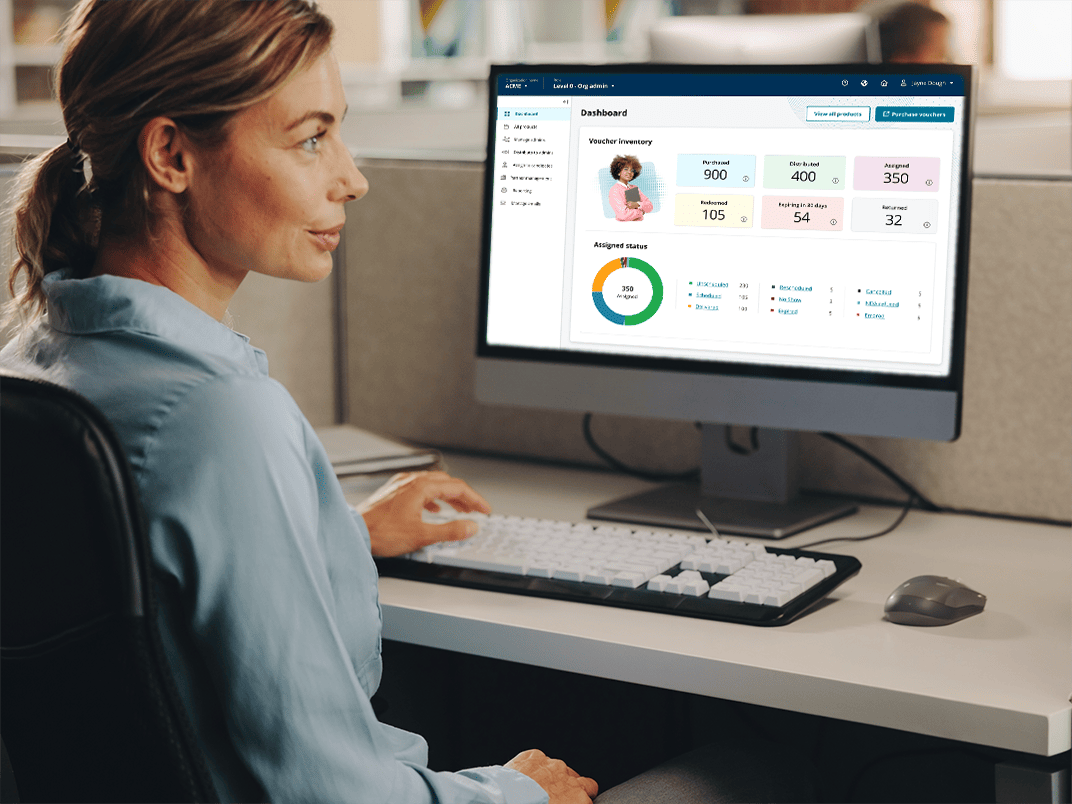
Reshaping an Enterprise Asset Platform Into a B2B Marketplace
How a three-year North Star design sprint compressed into a now/next/later roadmap, then shipped as a live MVP - re-architecting a B2B asset platform serving partners including Microsoft, Amazon, and Apple into a role-tiered, marketplace-style experience that cut admin time on task by 50%.
The starting point
A B2B asset platform that worked - but felt like beta.
The platform is the central tool partner administrators at major technology companies use to distribute high-value digital assets - certification vouchers, training entitlements, and product assignments - across their enterprise organizations. Partners like Microsoft, Amazon, and Apple onboarded onto the tool when they purchased asset volume above a 100-unit threshold.
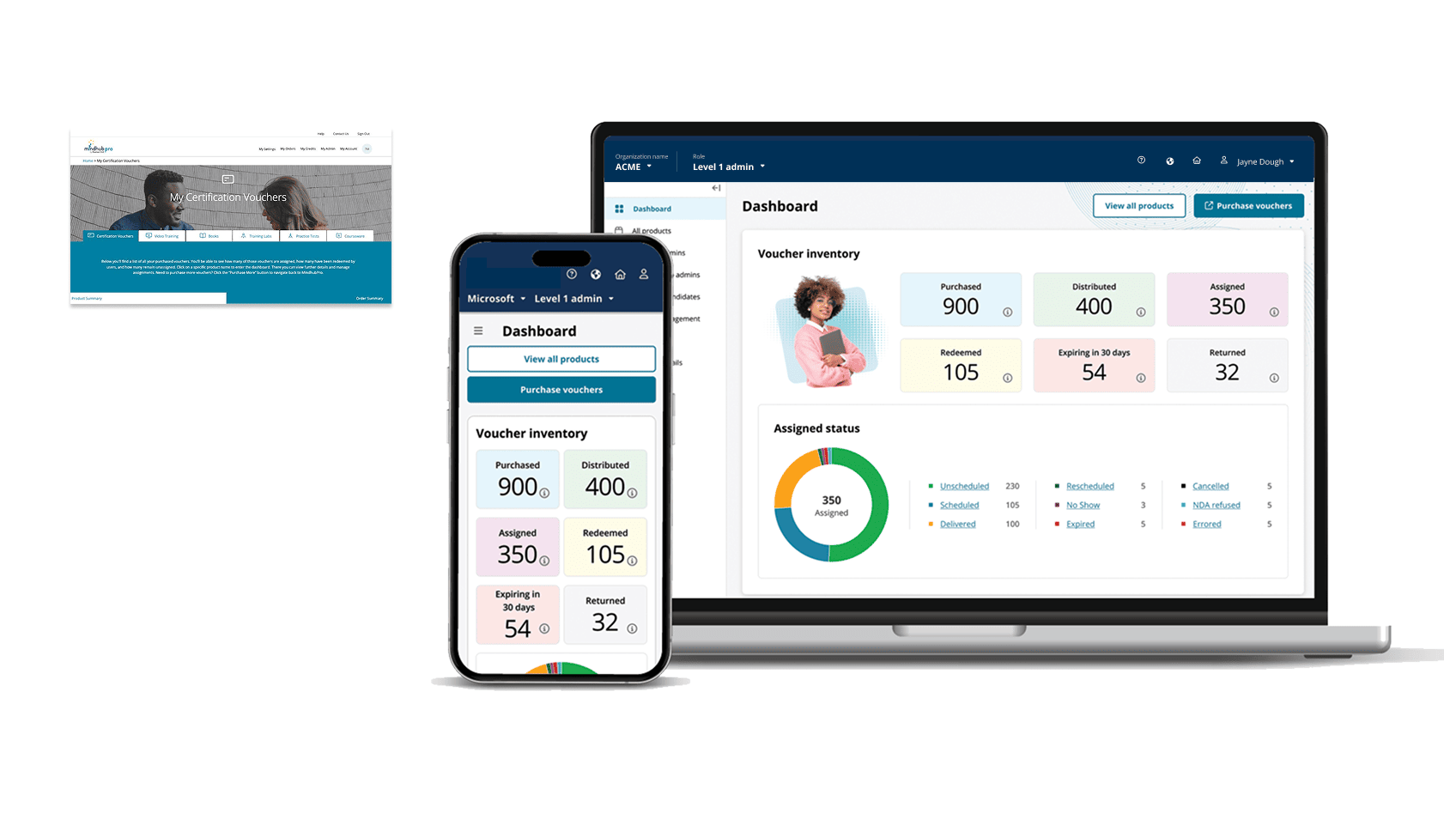
The product was real, but it was rough. Built additively, prioritizing function over experience, stakeholders described it directly: it looked like beta. Asset waste was a real cost. Each visit felt isolated. Admin role hierarchies were unclear. Navigation was buried. The inventory list - the most-used surface - lacked the affordances admins actually needed.
I led product design for the discovery engagement, the three-year North Star design sprint, and the MVP that shipped to production.
Discovery: stakeholder interviews and 16 opportunities
Three weeks of structured discovery across seven cross-functional stakeholders.
Discovery ran across three weeks. The structure was deliberate: seven scripted one-hour stakeholder interviews across Product, Engineering, Sales & Support, Marketing, Operations, Product Management leadership, and Business Development - plus a parallel artifact stream documenting site map, key user flows, customer journey, and persona archetypes.
The synthesis surfaced 16 opportunities, grouped into three categories so the work could move in parallel: customer experience and feature updates (6), workflow updates (8), and look-and-feel updates (2). I ran a prioritization framework that scored each opportunity on business value × user value × effort, producing a ranked top-five list that anchored the rest of the engagement.
The four priorities that shaped the North Star
From 16 opportunities to four anchor bets.
1. Asset waste minimization. Action-led dashboards surfacing real-time inventory state, plus bulk recovery flows so admins could reverse distribution mistakes without filing a support ticket.
2. Pass/Fail visibility. Universally requested across the partner network. End-user outcome data existed but wasn't surfaced to admins. The blocker was legal agreements - not technical - so I designed the feature, scoped the legal path, and prioritized it for a later release window.
3. Cosmetic lift via a shared enterprise design system. Aligning the platform with the rest of the enterprise estate's design system made the product visibly modern and created cross-product mental-model continuity.
4. Admin management visibility. Admin role hierarchy was core to how partners actually used the platform - but the structure was opaque. The redesign made admin hierarchy a first-class surface, enabling the assume-role flow that shipped later.
The three-year North Star design sprint
Map → Sketch → Decide → Prototype → Test, scoped to a 3-year horizon.
With the four anchor priorities locked, I ran a three-year North Star design sprint. The horizon mattered: most sprints chase a near-term feature - this one was framed against a three-year horizon, asking what the product could become if we designed past current constraints.
That choice was right for two reasons. Several priorities (pass/fail visibility, marketplace dynamics, two-way request flows) had real legal or technical lead times. Designing them into the North Star kept the team's vision aligned even when individual features had to wait. And the discovery work had surfaced a strategic question - is this a voucher tool or an asset platform? - that needed a three-year frame to answer.
From the vision, I worked with product and engineering to break the work into a now / next / later structure. The now bucket became the MVP I helped the team execute and ship.
Six decisions that shaped the MVP
From North Star vision to a buildable now-bucket.
1. Role-tiered dashboards as the spine. The MVP shipped three persona-tiered dashboards (Level 0 Purchaser/Distributor, Level 1 Distributor/Assigner, Level 2 Assigner) plus a Super Admin variant - same component system, different surface area per role. That choice is what made the persona work feasible to ship as one MVP.
2. Bulk return and bulk rollback as primary actions. The first time admins could recover an assignment mistake without filing a support ticket - the change that translated "looks like beta" into a measurable workflow improvement.
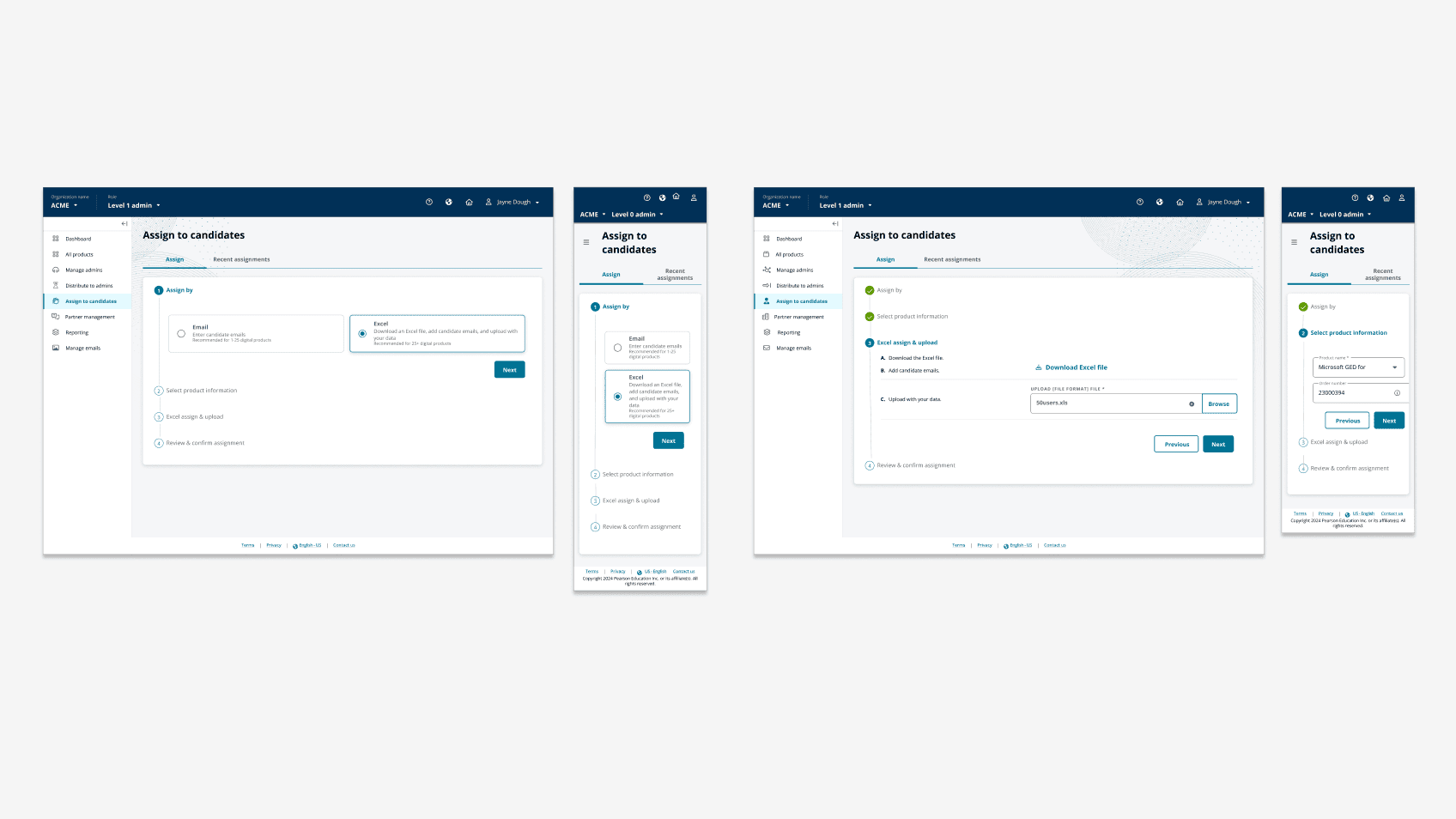
3. A multi-step distribution wizard for real partner complexity. Desktop and mobile, with country-select handling for international partners, Excel and email distribution paths, and country-aware product selection. A single distribution event for a partner regional team can span dozens of countries and thousands of recipients.
4. Admin role assumption. Authorized admins can step into another admin's view for troubleshooting and handoff - previously a support intervention. Required careful UX around audit trails and re-entry.
5. A shared design system applied end-to-end, with co-branding support. Every surface built on the shared design system; co-branded variants let partners deploy inside their own brand context.
6. Mobile responsive across every flow. Every shipped surface has desktop and mobile responsive layouts. Mobile is a first-class breakpoint, not an afterthought.
What shipped in the MVP
The now-bucket scope, fully responsive across desktop and mobile.
- Three role-tiered dashboards (Level 0, 1, 2) plus Super Admin and co-branded variants
- All Products / Inventory with filters, tabs, and bulk-action affordances
- Bulk voucher return and bulk voucher rollback - the asset-waste flows
- Distribute - a multi-step wizard with country select and Excel/email paths
- Assign - candidate-level assignment with Excel upload and email options
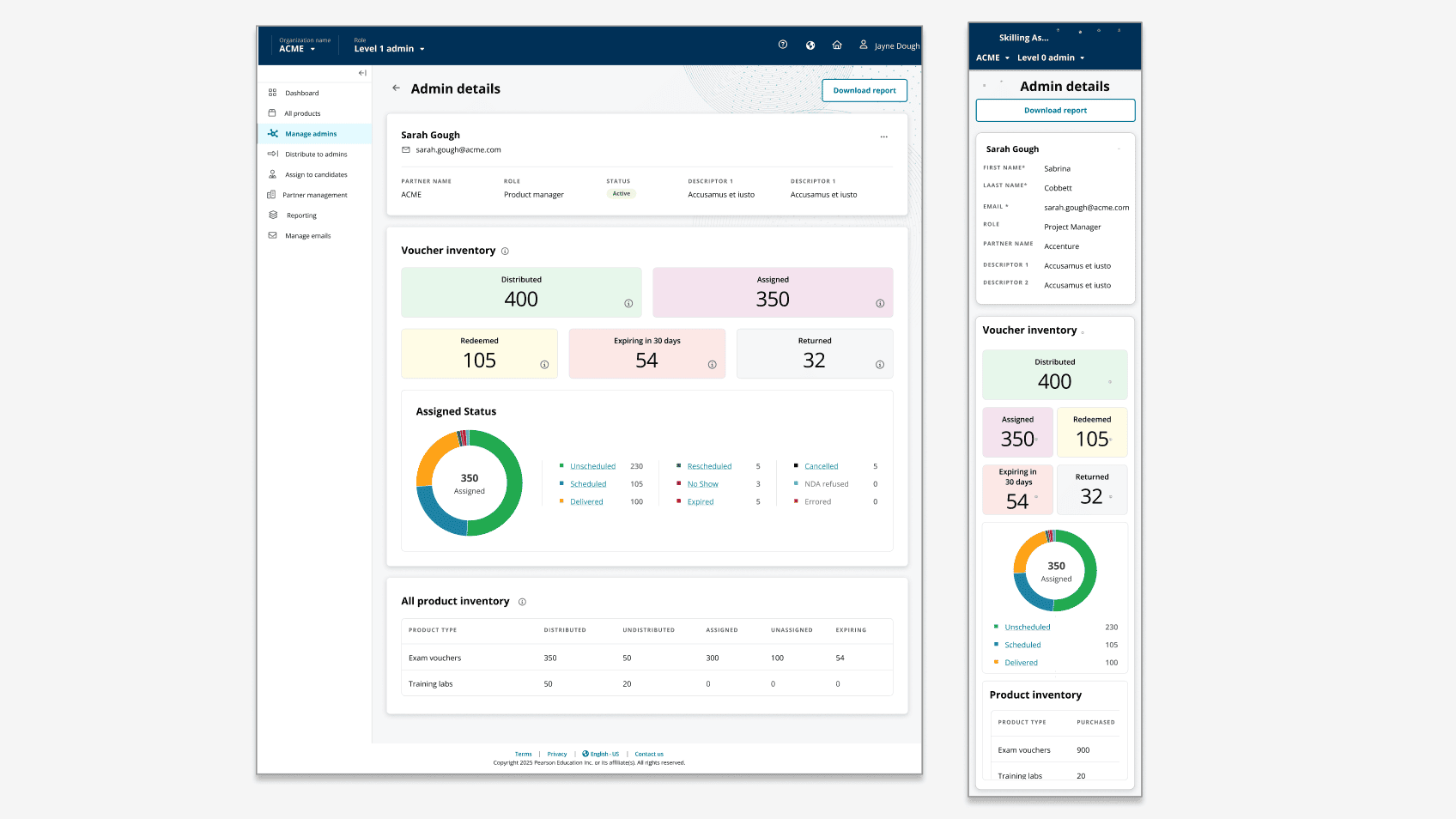
- Admin management with role hierarchy and the Assume role flow
- Reporting separated by Level 1 and Level 2 admin scopes, desktop and mobile
- Manage emails for distribution events
- Partner management for partner-specific configuration
- Localized Support and contact us pages
Items intentionally held in next and later: pass/fail visibility (waiting on legal agreements), deeper marketplace dynamics like seat reselling, two-way request flows, in-product notifications, and a conversational help interface. Each had a clear owner and a target window.
What changed for admins
The measurable outcome and the qualitative one.
The headline: 50% reduction in admin time on task across the most-used distribution and inventory workflows. The combined effect of role-tiered dashboards (fewer clicks to reach the relevant data), bulk return and rollback (no support-ticket loop for recoverable mistakes), and the redesigned inventory surface (filters, tabs, visible state replacing manual scanning).
The qualitative outcome is the one stakeholders had originally asked for. The platform looks like a tool that's part of a serious enterprise estate. It carries the same design language as other products in the partner ecosystem. The sales team is willing to demo it as a differentiator, not a footnote. Support escalations dropped because admins could now resolve their most common pain points inside the product surface itself.
What I took from this
Three-year vision, now-bucket execution.
The lesson I take from this work: a three-year North Star isn't a substitute for shipping. It's the structure that makes shipping coherent. Most enterprise modernization fails one of two ways - aspirational vision that never ships, or scattered MVPs that don't add up. The now / next / later structure was the bridge. The MVP wasn't a compromised version of the North Star; it was the deliberately scoped first chapter of it.
The other lesson: persona tiers as a system, not a feature. The role-tiered dashboards weren't four separate dashboards stitched together; they were the same component system rendering different surface area per role. Designing the system once, parameterized by role, is the senior version of this problem - and what made it feasible to ship in one MVP rather than splitting across multiple workstreams.